The Toyota Prado is a genuine body-on-frame 4×4, and it is the vehicle Barguts Tours’ Prado fleet recommends for routes that leave Nairobi’s tarmac. Its body-on-frame build and tall ground clearance do most of the work on rough roads, and higher trims add Multi-Terrain Select, Crawl Control, and KDSS, so a first-time off-road renter needs a steady pace rather than specialist technique. On murram roads, the Prado’s 210 to 221mm of ground clearance and full-time four-wheel drive clear corrugation that slows a lower SUV. Choose it over a standard SUV when your route includes murram, a national park, or an upcountry safari, and step up to the Land Cruiser safari van for a larger group.
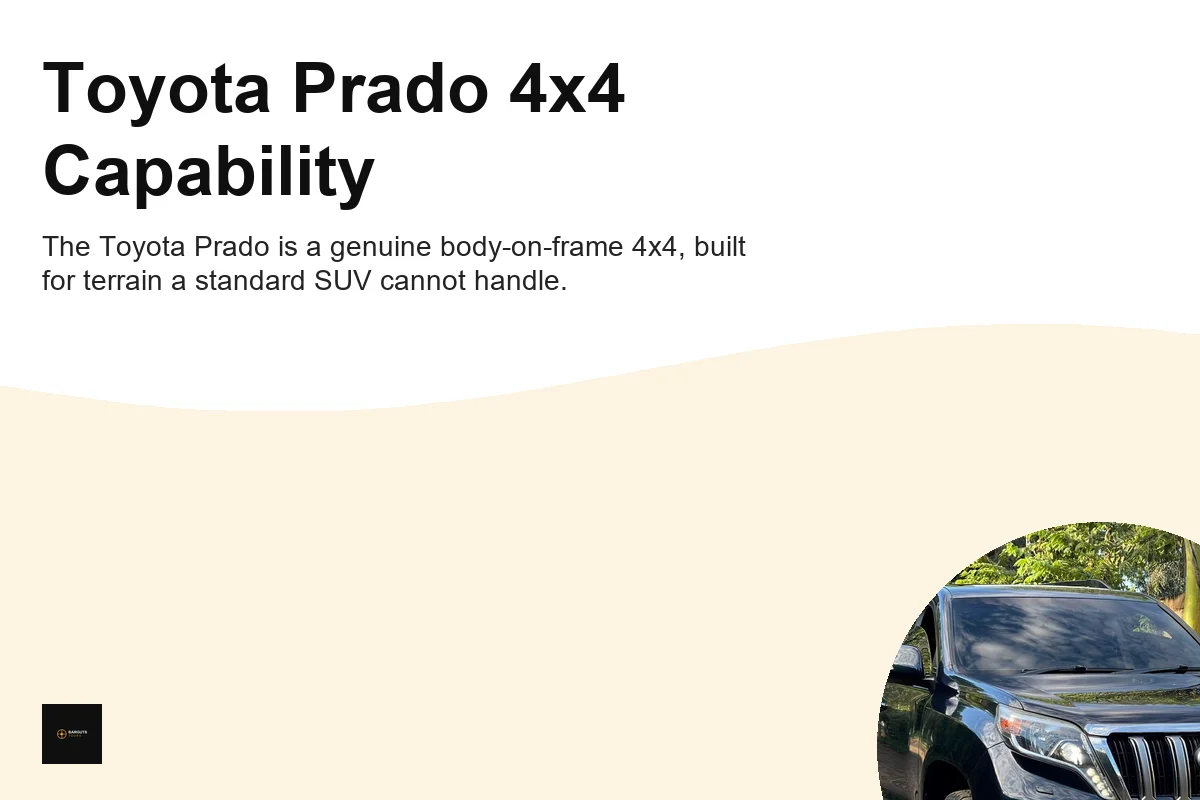
The Toyota Prado is a genuine body-on-frame 4×4, built for terrain a standard SUV cannot handle.
Is the Toyota Prado a Genuine 4×4 for Kenya’s Roads?
Yes, the Toyota Prado is a genuine body-on-frame 4×4, a construction method that gives it far more structural strength on rough terrain than a crossover SUV built on a car-style unibody frame. This is the real distinction between a Prado and many smaller SUVs in Nairobi’s hire market: the Prado is engineered from the ground up for off-road use, not adapted from a passenger-car platform.
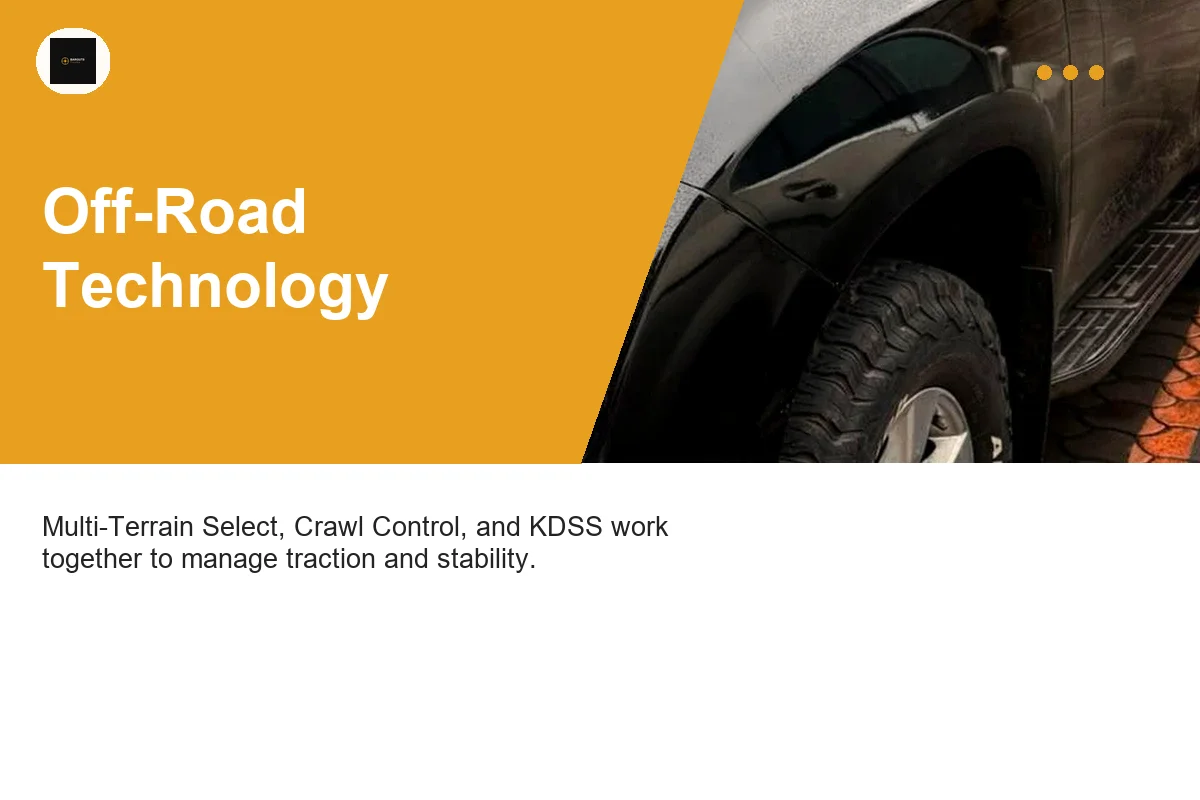
Multi-Terrain Select, Crawl Control, and KDSS work together to manage traction and stability.
Spec
Figure
Ground clearance (unladen)
210-221mm, varies by model year
Approach angle
31-32°
Departure angle
17°
Off-road technology (higher trims)
Multi-Terrain Select, Crawl Control, Kinetic Dynamic Suspension System (KDSS)
These are manufacturer-published figures, and the off-road systems in the last row are fitted to higher trims and newer generations, so confirm what your hired unit has at booking.
What Off-Road Technology Does the Prado Have?
On higher trims and newer generations, the Prado’s off-road technology includes Multi-Terrain Select, Crawl Control, and the Kinetic Dynamic Suspension System (KDSS), three systems that work together to manage traction, stability, and wheel articulation automatically. Multi-Terrain Select adjusts throttle and traction response for the surface you select, Crawl Control manages acceleration and braking automatically at very low speeds on technical terrain, and KDSS adjusts suspension stiffness to keep more wheels in contact with uneven ground. Barguts Tours’ fleet offering is the Prado TX, so ask which of these systems your unit has; every Prado still has the body-on-frame build and clearance that matter most on murram roads.
What Is the Prado’s Approach and Departure Angle?
The Prado’s approach angle is 31 to 32 degrees, and its departure angle is 17 degrees, both manufacturer-published figures describing how steep a slope the vehicle can climb or descend without the front or rear bumper striking the ground. A higher approach angle matters most on a steep entry point, such as a riverbank crossing or a rutted driveway into a lodge.
What Is KDSS and Why Does It Matter on Uneven Ground?
KDSS, the Kinetic Dynamic Suspension System fitted to higher-trim Prados, matters on uneven ground because it adjusts suspension stiffness automatically to keep more of the vehicle’s wheels in contact with the surface at once. On a flat road, the system keeps the body stable and level for comfort. Once the Prado hits a rutted or uneven section, such as a murram road with deep corrugation on one side, KDSS allows more wheel articulation, so a wheel can drop into a rut while the others keep their grip, rather than the whole vehicle tipping or losing traction.
What Is It Like to Self-Drive the Prado on a Rough Road for the First Time?
Self-driving the Prado on a rough road for the first time feels more stable and less demanding than its size suggests, largely because its ground clearance and four-wheel drive absorb most of what a rough road throws at it. A first-time renter does not need prior 4×4 experience to use the vehicle safely on a graded murram road.
The main adjustment is pace, not technique: a slower, steadier speed over corrugation and loose surface material reduces strain on the vehicle and keeps the ride comfortable, while trying to drive a murram road at tarmac speed is where most self-drive renters, in any vehicle, run into trouble. Barguts Tours briefs every self-drive renter on the specific route before departure, including which sections call for a slower pace.
How Does the Prado Handle Murram and Rough Roads Specifically?
The Prado handles murram and rough roads with its tall ground clearance and full-time four-wheel drive, both built for exactly this kind of surface. Murram, Kenya’s common unpaved gravel road surface, develops corrugation and loose material that can catch a lower-clearance vehicle’s underbody, and the Prado’s clearance is specifically suited to clearing this without constant slow-speed caution.
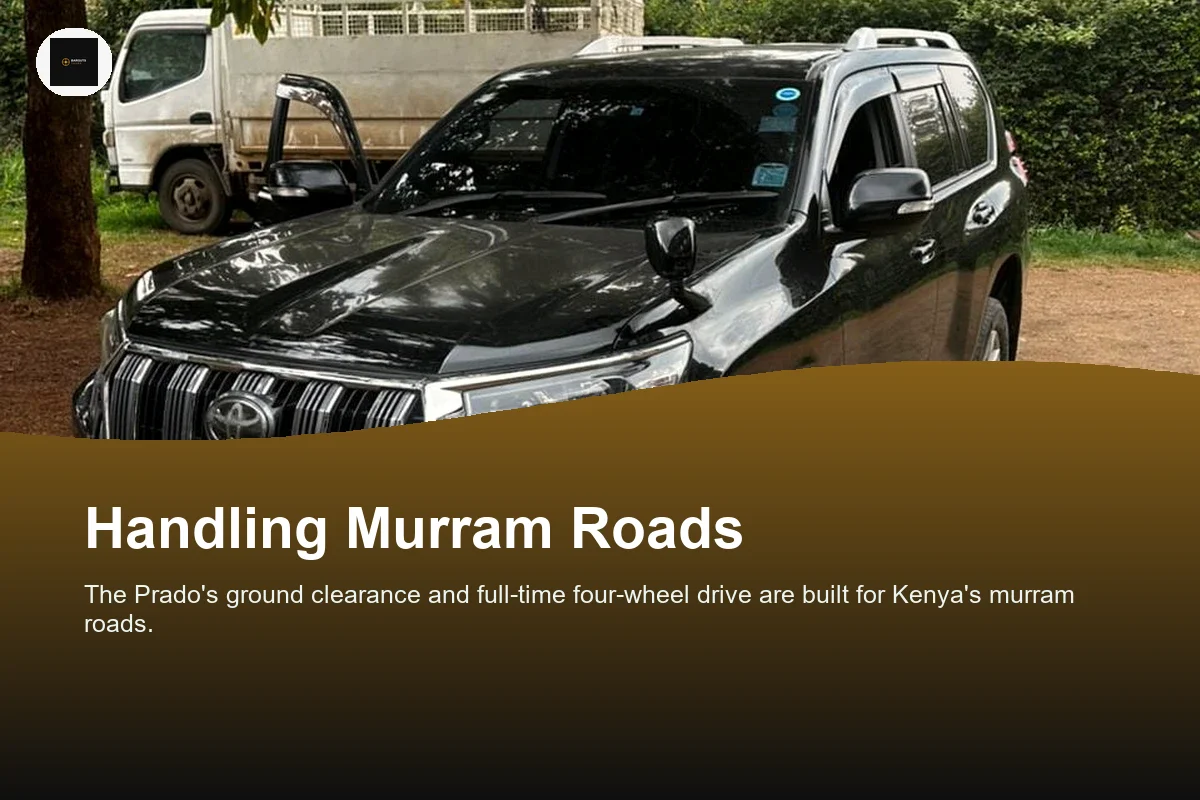
The Prado’s ground clearance and full-time four-wheel drive are built for Kenya’s murram roads.
In Kenya specifically, the Prado has a genuine real-world track record on this kind of terrain: it is widely used by corporate executives and government agencies who need a vehicle that moves comfortably between Nairobi’s business districts and rural or rough terrain in the same working day. That dual-use pattern, tarmac in the morning and murram by the afternoon, is a realistic description of what many Barguts Tours renters actually do with the vehicle.
Does the Dry or Wet Season Change How the Prado Handles Murram Roads?
Yes, the dry season makes murram roads firmer and easier to drive, while the wet season, roughly March to May and October to December, softens the surface and makes it more prone to rutting. The Prado’s ground clearance and traction help in both conditions, but a wet-season murram route calls for a slower, more deliberate pace than the same route in July or August, when the ground is at its firmest.
Need a Car in Nairobi?
Self-drive & chauffeur hire available today — same-day quote in minutes.
When Should You Choose the Prado Over a Standard SUV?
Choose the Prado over a standard SUV when your route includes murram roads, a national park, or an upcountry safari. A standard SUV is the practical, lower-cost choice for city driving and tarmac-only routes, where the Prado’s extra ground clearance and off-road systems go unused.
The decision point is really about where your route goes after it leaves Nairobi’s main roads, not a general preference for a bigger vehicle. A route that stays on the Nairobi-Nakuru highway, for example, does not need the Prado’s capability; a route that turns off toward a park gate on murram usually does. See current car hire rates in Nairobi for the Prado’s daily rate against the rest of the fleet.
How Does the Prado’s Capability Compare to the Fleet’s Other 4×4 Options?
The Prado’s capability sits between a standard SUV and the Land Cruiser safari van in the fleet’s lineup, making it the practical middle choice for most upcountry and safari trips. A standard SUV such as the RAV4 or X-Trail handles good tarmac and light gravel comfortably but is not built for sustained murram or technical terrain. The Land Cruiser safari van goes further again, with a larger body and higher-capacity design suited to multi-vehicle group safaris.
For a self-drive renter or a small group travelling to a single national park or safari destination, the Prado’s combination of genuine off-road capability and a manageable size for a first-time off-road driver is usually the better fit than either the standard SUV or the larger Land Cruiser.
Does Ground Clearance Change Across Prado Trims and Hire Options?
Ground clearance is broadly consistent across the Prado range, with the real variation in Barguts Tours’ own fleet coming down to the standard-versus-sunroof choice rather than a change in off-road capability. See Prado ground clearance on murram roads for the exact figures and what they mean on a real Nairobi-to-safari route.
Frequently Asked Questions About Toyota Prado 4×4 Capability
Can the Toyota Prado Handle a Safari Route Without a Driver’s Off-Road Experience?
Yes, the Prado is forgiving enough for a first-time off-road self-drive renter, provided you drive at a sensible pace and use the vehicle’s assisted systems rather than relying purely on manual technique.
Is the Prado Better Than a Land Cruiser for Murram Roads?
Both handle murram roads well; the Land Cruiser is the larger, higher-capacity option for group safaris, while the Prado suits smaller groups and a more manageable size for self-drive renters less confident with a bigger vehicle.
Does the Prado’s 4×4 System Need to Be Switched On Manually?
Confirm the specific drivetrain mode of your hired unit with Barguts Tours at pickup, since Prado generations vary between full-time and selectable four-wheel drive, and this detail is worth confirming rather than assuming.
Sources
Barguts Tours Prado fleet details and daily rates, September 2026.
Toyota Land Cruiser Prado manufacturer specifications: ground clearance, approach and departure angles, and off-road systems.
Contact Barguts Tours on WhatsApp to confirm Prado availability and the exact specification of your fleet unit before your trip.
Barguts Tours — Nairobi
Looking for a Reliable Vehicle in Nairobi?
NTSA-licensed, fully insured hire — self-drive, chauffeur, airport transfer, or safari. Same-day confirmation, seven days a week.