A rental car inspection checklist records your hire vehicle’s exact condition at pickup, so you cannot be charged for pre-existing damage when you return it. Rental companies compare the car’s condition at pickup with its condition at return. Any damage found at return that was not recorded at pickup can become your responsibility. Three steps protect you: walk the exterior systematically, check the interior before you sign, and photograph every mark before you drive away.
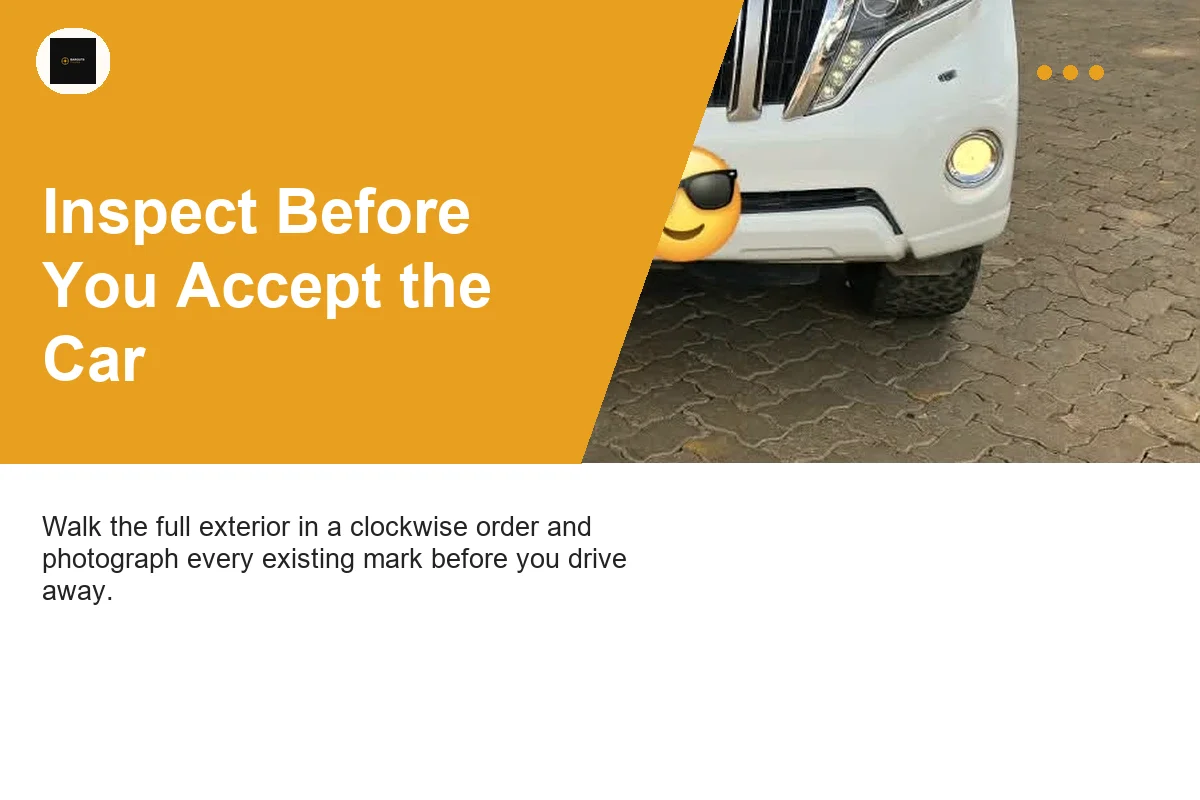
Walk the full exterior in a clockwise order and photograph every existing mark before you drive away.
What Is a Rental Car Inspection Checklist?
A rental car inspection checklist is a signed condition record that you and the hire company complete at pickup, and again at return. It fixes the car’s condition at each handover point.
The checklist records the condition of each exterior panel, the interior condition, the fuel level, the odometer reading, any existing damage, and both parties’ signatures. It is the baseline for deciding liability at return.
Many operators use a pickup form and a return form. Any damage found at return that is not on the pickup form is at risk of being charged to the renter. Even when the company supplies a form, do your own walk-around and take your own photographs. The company’s form protects the company. Your photographs protect you.
Why Does Skipping the Vehicle Inspection Risk Your Deposit?
Skipping the inspection leaves you with full liability for pre-existing damage, because without a signed record of the car’s condition at pickup, the company’s return assessment is the only evidence.
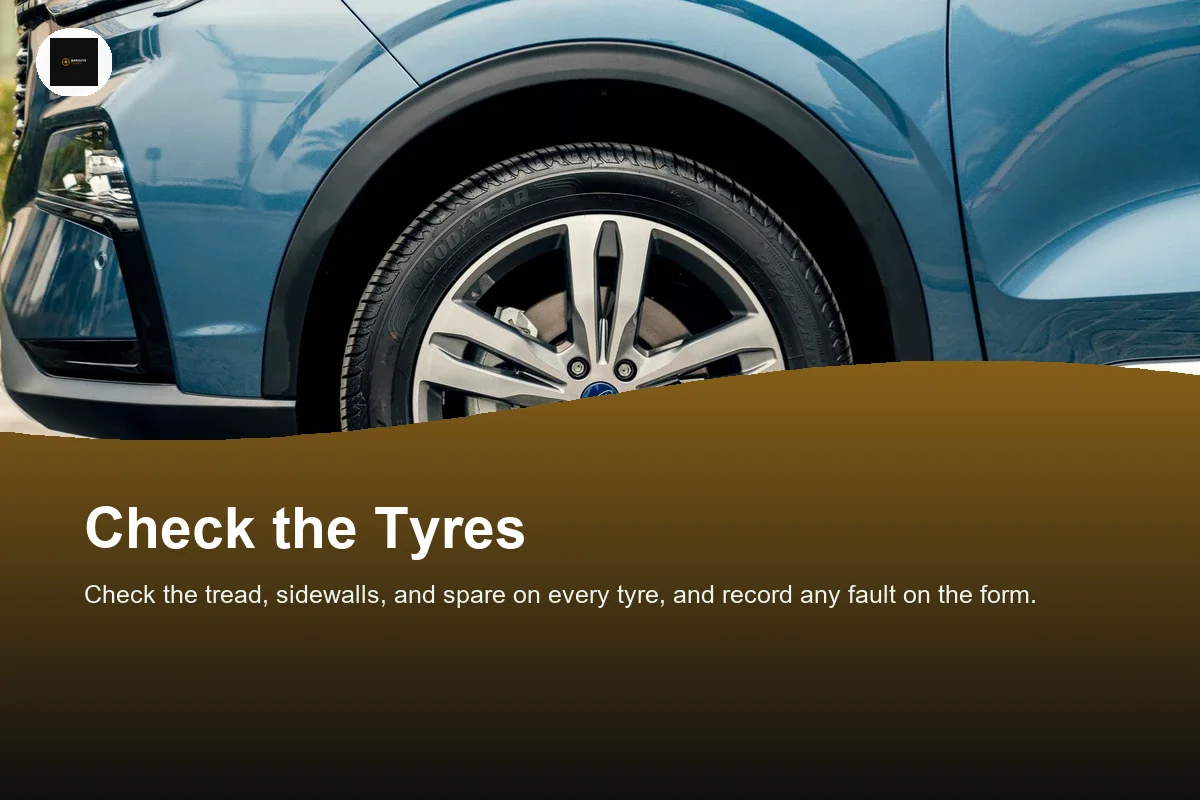
Check the tread, sidewalls, and spare on every tyre, and record any fault on the form.
Most Barguts Tours hire takes no deposit. Game-drive hire is the exception, with a refundable deposit of 50% of the total hire cost. Without a pickup record, damage found at return can justify withholding some or all of that deposit. The inspection takes under 15 minutes and costs nothing.
What Is the Difference Between a Pickup Inspection and a Return Inspection?
The key difference between a pickup inspection and a return inspection is who has to prove the car’s condition. At pickup, the company records the condition it hands over. At return, you must show that any damage found was already there or did not happen during your hire.
The five ways a pickup inspection and a return inspection differ are:
Aspect
Pickup Inspection
Return Inspection
Purpose
Record the car’s condition before the hire starts
Compare the current condition with the pickup record
Who completes it
You and the agent, both signing
The agent, with you present
Best conditions
Daylight, before the keys are handed over
Immediately at return, before the car moves to the lot
If damage is found
Report it, have the agent note it on the form, and photograph it before signing
Dispute it using your pickup photographs, if the mark was already there
Risk if skipped
Liability for all damage found at return, including pre-existing damage
No evidence to challenge a damage claim
Inspect in daylight where possible. Covered car parks hide panel damage that direct light reveals straight away.
What to Check on the Exterior of a Rental Car in Kenya
To inspect the exterior, walk the full perimeter of the car in a systematic clockwise order, starting at the front-left corner. Covering every zone in order avoids missed panels and repeated checks. Photograph each zone before you move to the next. A full walk-around takes about three to four minutes on a standard vehicle.
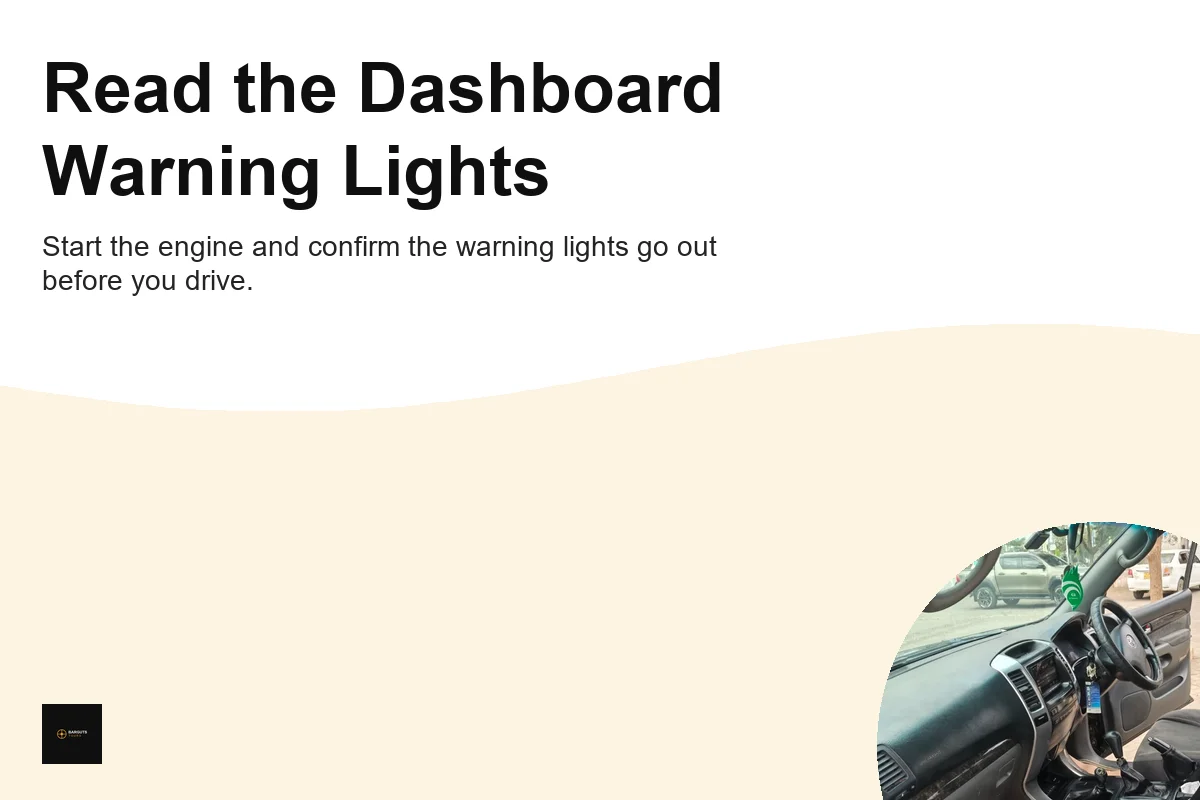
Start the engine and confirm the warning lights go out before you drive.
The six exterior zones to check on any rental car in Kenya are:
Body panels (bonnet, all four doors, boot lid): look for dents, deep scratches, and paint transfer. Feel for filler repairs in low light.
Bumpers (front and rear): look for cracks, missing clips, and misalignment with the body lines, which can indicate a prior repair.
Glass (windscreen, rear window, side windows): note every chip and crack, including hairline cracks at the corners.
Exterior lights (headlights, tail lights, brake lights, indicators, reversing lights): confirm the housings are intact and the lights work.
Tyres (all four road tyres and the spare): check tread depth, sidewall cuts or bulges, and uneven wear.
Undercarriage (the area visible beneath the sills and behind the wheels): look for fresh scrape marks, especially on SUVs and 4x4s that may have been used off-road.
Photograph each zone from arm’s length, and do not take every photograph from one position, because that hides damage on the opposite panels.
Which Body Panels and Bumpers Show the Most Damage?
The rear bumper and the driver-side front door show the most low-speed contact on city hire cars. Tight parking in the CBD, Westlands, and Kilimani causes most of it. Rear bumpers take contact from parallel parking and reversing, and driver-side doors take chips from neighbouring cars in shopping-centre car parks. Take two photographs of each: an overview and a close-up.
On safari and upcountry vehicles, check the underside guard and both tow points. Murram corrugations and drainage culverts scrape those areas. Fresh scrapes on a dark underbody guard show recent off-road use. Check the metal behind those scrapes for dents or bends.
How Do You Inspect the Tyres on a Hire Car Before Driving Away in Kenya?
To inspect the tyres on a hire car, check five attributes on each road tyre and the spare before you accept the vehicle. A tyre fault on an upcountry route is a safety risk, and it can become a charge at return if it is not recorded at pickup.
The five tyre checks to complete at pickup are:
Tread depth: check the wear indicators, the small raised bars moulded into the tread grooves. If the tread is level with them, the tyre is worn down.
Sidewalls: run your hand around each sidewall and look for cuts, bulges, or embedded nails. A bulge can mean internal damage that causes a sudden blowout.
Pressure: an under-inflated tyre looks lower at the contact patch. Ask the agent to check pressure with a gauge if any tyre looks uneven.
Spare: confirm it is a full-size spare, not a temporary space-saver. Check its tread and pressure.
Wear pattern: uneven wear suggests over-inflation, under-inflation, or misalignment. Each affects braking and stability at speed.
Report any tyre fault before you drive, and record it on the form.
What to Check Inside a Rental Car Before You Sign in Kenya
To complete the interior inspection, check the fuel gauge, the dashboard, the air conditioning, every seat, and the vehicle documents before the agent hands over the keys and you sign the agreement. The interior check takes about five minutes and matters as much as the exterior walk-around.
Need a Car in Nairobi?
Self-drive & chauffeur hire available today — same-day quote in minutes.
Turn the ignition to the “on” position without starting the engine. This lets the dashboard warning lights come on and self-test.
The interior items to inspect and record at every hire car pickup are:
Fuel gauge: photograph it with the ignition on. Confirm the fuel policy and the level you must return the car at, and make sure both are written on the agreement before you sign.
Dashboard warning lights: start the engine and confirm the lights go out. Any light that stays on must be recorded before you drive.
Air conditioning: run it on maximum cold for about a minute to confirm it produces cold air.
Seats, front and rear: check the fabric or leather for tears, stains, and broken adjustment mechanisms. Photograph any existing damage.
Interior trim and handles: check door handles, grab handles, and glove box catches for cracks or missing pieces.
Spare wheel, jack, and wheel brace: confirm all three are present and accessible before you leave.
Vehicle documents: confirm the logbook, the insurance certificate, and the current NTSA inspection sticker are in the car.
A short video that sweeps from the dashboard to the rear seats, with the engine running, creates one time-stamped interior record. It is faster than photographing each item.
How Do You Verify the Fuel Level at Rental Car Pickup in Kenya?
To verify the fuel level at pickup, photograph the dashboard fuel gauge with the ignition on before the agent hands over the keys. Then check that the reading matches the level on the inspection form.
Confirm the fuel policy before you drive. At Barguts Tours, you return the car at the same fuel level you collected it, so the level on the form is the level you must return. If the gauge and the form disagree, do not drive off until the form is corrected.
Which Dashboard Warning Lights Mean You Should Not Accept the Car?
The warning lights that mean you should not accept the car are the engine management light, the oil pressure warning, and the brake system warning. Each signals a fault that affects safety or can cause major damage.
Most other lights are informational, such as service reminders and low tyre pressure. Those can be recorded on the form and accepted if the agent confirms the cause in writing.
The three warning lights that justify refusing a rental car are:
Engine management light (orange engine symbol): a stored engine fault. The car may run in town but fail on a long upcountry route.
Oil pressure warning (red oil-can symbol): low oil pressure can damage the engine quickly. Do not drive if this light stays on after you start the engine.
Brake system warning (red brake or ABS symbol): a braking fault. Do not accept the car until it is repaired.
How Do You Document the Rental Car Condition at Pickup in Kenya?
To document the car at pickup, photograph it from four corners, close up every existing mark, and send all images to the agent’s WhatsApp before you leave the lot. The WhatsApp timestamps create a record that predates your hire.
The five documentation steps to complete at every pickup are:
Photograph all four corners from about three metres, front-left, rear-left, rear-right, and front-right, before you touch the car.
Move closer and photograph each existing mark individually. Place a coin or your hand beside each mark for scale.
Open every door and the boot. Photograph the door seals, the sills, and the boot floor, where damage is often missed in exterior shots.
Photograph the fuel gauge with the ignition on, and check it against the form before you sign.
Send all photographs to the agent’s WhatsApp, wait for the delivery tick, then screenshot the conversation. Save the images to cloud storage before you drive away.
The full process takes about 8 to 12 minutes. Complete it before you sign the agreement, not after.
What Photographs Should You Take Before Accepting a Hire Car in Kenya?
Photograph every existing mark on the car individually, even marks the agent says are too small to matter. A close-up photograph is the main evidence against a claim for a mark that was already there.
Use two tiers of photograph. Overview shots show the whole panel and where the mark sits. Close-up shots show each mark in detail. You need both. Overviews alone cannot prove a specific mark, and close-ups alone do not show where on the car the mark is.
WhatsApp is the most practical way to create a shared, timestamped record. Send the photographs before you sign, screenshot the delivery and read receipts, and save everything to cloud storage in the same session. Photographs sent after the hire ends are much weaker evidence.
Should You Use a Digital Inspection Form or a Paper Checklist in Kenya?
A digital record is the stronger option, because it carries a timestamp and can be shared immediately. Use the company’s form if it provides one, and keep your own photographs as well. Whatever format you use, sign only when the form matches what you saw.
Can You Reject a Rental Car in Kenya If the Agent Will Not Record Damage?
Yes, you should not accept a car that has damage the agent refuses to record on the form. Ask the agent to note the damage in writing, photograph it, and confirm the form before you sign. If the agent still refuses, do not drive off. Contact Barguts Tours directly to resolve the question before you leave.
Sources
Barguts Tours payment and deposit terms, September 2026.
Contact Barguts Tours on WhatsApp before your pickup to confirm the deposit, the fuel policy, and the inspection process for your vehicle.
Barguts Tours — Nairobi
Looking for a Reliable Vehicle in Nairobi?
NTSA-licensed, fully insured hire — self-drive, chauffeur, airport transfer, or safari. Same-day confirmation, seven days a week.