Nairobi National Park is fully open to self-drive visitors — you enter at the main Langata gate, pay the gate entry fee via the KWSpay eCitizen portal, and drive the park’s network of paved and gravel internal tracks without a guide. Entry fees for non-residents are USD 60 per adult in high season and USD 45 in low season, with the park open daily from 6:00 AM to 6:00 PM.
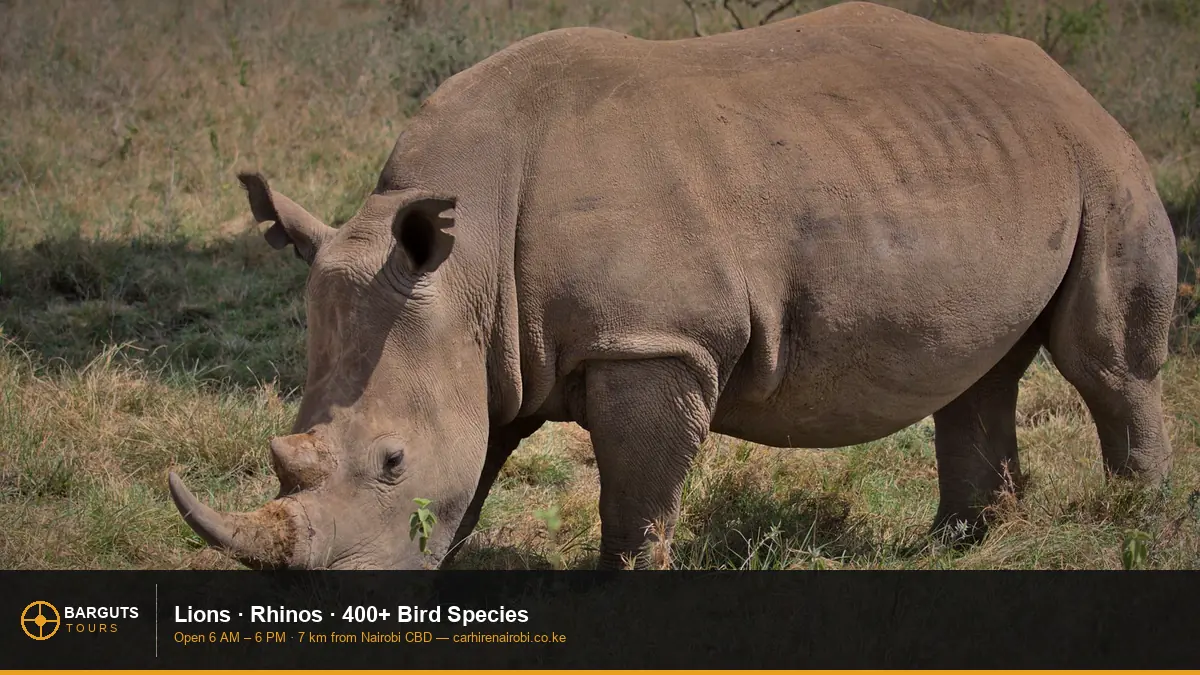
Wildlife commonly spotted on a self-drive includes lions, leopards, rhinos, giraffes, and over 400 bird species — with the city skyline as a backdrop, making it one of Africa’s most distinctive game drive settings.
A standard saloon or hatchback is sufficient for Nairobi National Park’s maintained internal tracks, unlike the murram roads of Maasai Mara or Tsavo. The 4 main self-drive routes inside the park are the Hippo Pools loop, the Ivory Burning Site route, the rhino sanctuary circuit, and the southern boundary track.
KEY TAKEAWAYS
Nairobi National Park is fully open to self-drive visitors — no guide is required.
The main entry point is Langata Gate, 7 km from Nairobi CBD.
Non-resident entry fees are USD 60 per adult (high season) and USD 45 (low season); all fees paid via KWSpay eCitizen.
The vehicle entry fee is KES 600 for a standard private car.
The park opens at 6:00 AM and closes at 6:00 PM daily — all vehicles must exit by 6:00 PM.
The best game drive window is 6:00–9:00 AM when wildlife is most active.
A standard saloon or hatchback is sufficient — NNP’s internal tracks are graded and maintained.
The 4 top self-drive routes are the Hippo Pools loop, Ivory Burning Site route, rhino sanctuary circuit, and southern boundary track.
Can You Self-Drive in Nairobi National Park?
Yes, Nairobi National Park is fully open to self-drive visitors — you enter at the main Langata gate, pay the gate entry fee via the KWSpay eCitizen portal, and drive the park’s network of paved and gravel internal tracks without a guide.
This is the key differentiator that makes NNP the best first self-drive park in Kenya: no guide requirement, no murram roads, and a 20-minute drive from the Nairobi CBD — and a natural first stop on any road trip from Nairobi. A KWS ranger-guide is available optionally at the gate for approximately KES 2,000 per 4-hour session if you want tracking expertise.
For a comparison of self-drive requirements across all parks accessible from Nairobi, see the guide on self-drive safari from Nairobi.
What Are the Entry Fees for Nairobi National Park?
The entry fee for Nairobi National Park for non-residents is USD 60 per adult in high season and USD 45 in low season — Kenyan residents and citizens pay reduced KWS rates, and all fees are payable online via the KWSpay eCitizen portal (ecitizen.go.ke) or at the gate via Mpesa. High season runs from July to October and December to February; low season is March to June and November.
Visitor type
High season fee
Low season fee
Vehicle fee
Non-resident adult
USD 60
USD 45
KES 600 per entry
Non-resident child (3–12)
USD 30
USD 25
—
Kenyan resident adult
KES 500
KES 300
KES 200
Kenyan resident child (3–12)
KES 200
KES 150
—
Fee data sourced from Kenya Wildlife Service (kws.go.ke). Fees are reviewed annually — confirm current rates via the KWSpay eCitizen portal before visiting. The KES 600 vehicle entry fee applies to all standard private cars at every visit.
What Are the Opening Hours of Nairobi National Park?
Nairobi National Park opens at 6:00 AM and closes at 6:00 PM daily — all vehicles must be back at the Langata gate by 6:00 PM or face a late-exit penalty charged by KWS. Gate hours are consistent year-round, including public holidays.
The optimal game drive window is 6:00–9:00 AM: wildlife is most active in the first 3 hours of daylight, temperatures are cooler, and the low-angle morning light makes for better photography. Arriving at the gate at 6:00 AM opening ensures you have a full 3-hour morning game drive before the midday lull.
What Can You See on a Self-Drive in Nairobi National Park?
Nairobi National Park’s rhino sanctuary holds one of Kenya’s largest protected black rhino populations — the park also hosts resident lions, leopards, giraffes, zebras, Cape buffaloes, and over 400 bird species.
The wildlife commonly spotted on a self-drive in Nairobi National Park includes lions, leopards, rhinos, giraffes, zebras, and over 400 bird species — the park’s unique city skyline backdrop makes it one of Africa’s most distinctive game drive settings (Source: Kenya Wildlife Service).
The 10 most frequently sighted species on a Nairobi National Park self-drive:
Lions — the park hosts a resident pride; most commonly sighted near the southern boundary and Hippo Pools area
Leopards — elusive but present; rocky outcrops along the park’s central ridges are primary territory
Black rhinos — NNP’s rhino sanctuary holds one of Kenya’s largest protected black rhino populations
Giraffes — abundant throughout the park; commonly seen in the open grassland sections
Zebras — high density across all internal tracks; most visible in the morning hours
Cape buffaloes — large herds near the eastern section and Hippo Pools loop
Ostriches — frequently spotted on open grassland stretches near the southern boundary
Hippos — resident pods at the Hippo Pools area in the northwestern section
Crocodiles — along the Athi River southern boundary; visible from the riverbank track
Over 400 bird species — including the African fish eagle, secretary bird, and marabou stork
Elephant populations do not reside permanently inside Nairobi National Park — occasional sightings occur during movement through the southern wildlife corridor. Buffalo, rhino, and lion are year-round residents.
What Vehicle Do You Need for Nairobi National Park?
Nairobi National Park can be self-driven in a standard saloon or hatchback — its internal tracks are graded and maintained, unlike the murram roads of Maasai Mara or Tsavo. The paved main circuit and graded gravel tracks are accessible to all standard vehicles including economy saloons, compact hatchbacks, and crossover SUVs.
Need a Car in Nairobi?
Self-drive & chauffeur hire available today — same-day quote in minutes.
If you plan to do a half-day game drive in NNP followed by an upcountry route later in the same trip, book the vehicle class appropriate for your most demanding destination. For a guide on which vehicle you need for other Kenya parks, see what vehicle you need for other Kenya parks.
Top Self-Drive Routes Inside Nairobi National Park
The Hippo Pools loop in Nairobi National Park’s northwestern section follows the Nairobi River gorge — hippos are visible in the pools year-round and predators frequently patrol the surrounding rocky outcrops.
The 4 main self-drive routes inside Nairobi National Park are the Hippo Pools loop, the Ivory Burning Site route, the rhino sanctuary circuit, and the southern boundary track — each covering different terrain and offering distinct wildlife sightings.
The 4 recommended self-drive routes and their primary sightings:
Hippo Pools loop — northwestern section; follows the Nairobi River gorge; hippos in the pools year-round; lions and leopards frequently sighted on surrounding rocky outcrops
Ivory Burning Site route — historical landmark route through open grassland; excellent for zebras, giraffes, and ostriches; accessible by saloon car throughout
Rhino sanctuary circuit — dedicated KWS rhino area in the northeastern section; highest probability of black rhino sighting in Kenya within a city radius; requires a gate permit stamp to enter
Southern boundary track — follows the Athi River; closest route to the city skyline backdrop; crocodiles and buffaloes along the riverbank; excellent morning bird activity
Each route takes approximately 1–1.5 hours to complete. A full morning game drive (6:00 AM to 12:00 PM) allows completion of 2–3 routes with time to stop at sightings.
What Do You Need to Enter Nairobi National Park by Car?
To enter Nairobi National Park by car, you need a valid KWS entry ticket paid via the KWSpay eCitizen portal, your driving licence, and the vehicle registration document. Barguts Tours hire vehicles are cleared for national park entry; confirm this at pickup for any hire intended for a NNP game drive.
If you are hiring a car and plan to self-drive NNP on the same booking, book the park entry online the evening before to avoid queuing at the gate during the 6:00 AM opening rush.
How Far Is Nairobi National Park from the CBD?
Nairobi National Park’s main Langata gate is 7 km from Nairobi CBD — a 20–30 minute drive depending on traffic, making it the only national park in the world accessible from a capital city. Langata Road connects the CBD to the gate directly with no tarmac section change.
NNP is the most accessible self-drive park from Nairobi and the lowest-cost option for a half-day game drive during a city stay. If you are combining a NNP game drive with a broader Nairobi city itinerary, see the guide on a Nairobi 3-day itinerary with a hire car for suggested day-by-day planning.
Can you do Nairobi National Park without a guide?
Yes, Nairobi National Park does not require a guide for self-drive visitors — you pay the KWS gate entry fee and drive the internal tracks at your own pace. An optional KWS ranger-guide is available at the main Langata gate for approximately KES 2,000 per 4-hour session, which significantly improves tracking success for predators. Most self-drivers complete the Hippo Pools loop and rhino sanctuary circuit without a guide.
Is it safe to self-drive in Nairobi National Park?
Yes, self-driving in Nairobi National Park is considered safe — the park has a resident KWS ranger force, functioning entry and exit gates, and maintained internal tracks with clear signage. You must remain in your vehicle at all times during the game drive (except at designated exit points such as Hippo Pools platform). Do not leave the park after gate closing time (6:00 PM) as a late-exit penalty applies.
Can you see the Big Five in Nairobi National Park?
No, the full Big Five are not present in Nairobi National Park — the park does not hold a resident elephant or buffalo-and-elephant combination that qualifies it as a Big Five destination. Lions, leopards, black rhinos, Cape buffaloes, and hippos are all present, but elephants are rare visitors rather than residents. For the full Big Five, Amboseli or Tsavo East are the nearest alternatives from Nairobi.
Do you need to book Nairobi National Park in advance?
No, advance booking is not mandatory for Nairobi National Park — gate entry can be paid on arrival via the KWSpay eCitizen portal or Mpesa. Pre-booking online through the eCitizen portal (ecitizen.go.ke) saves time at the gate and is recommended during peak season (July–September) when morning queues at Langata gate can run 15–20 minutes at 6:00 AM opening.
Barguts Tours — Nairobi
Looking for a Reliable Vehicle in Nairobi?
NTSA-licensed, fully insured hire — self-drive, chauffeur, airport transfer, or safari. Same-day confirmation, seven days a week.